Dental Implants in Türkiye
Titanium roots that restore a single tooth or a whole jaw, placed with 3D-guided planning.
Learn more
Dental clinic · Çankaya, Ankara
Clinova Dental treats international patients in Ankara — implants, full-arch rehabilitation and aesthetic dentistry planned in three dimensions, quoted as a fixed all-inclusive price, and delivered by a team that works in your language.
 Implant plan
Clinova Dental · Specimen · not a real patient
Implant plan
Clinova Dental · Specimen · not a real patient
All-inclusive price Fixed in writing before you fly
Smile design in zirconia
Clinova Dental · Specimen · not a real patient
All-inclusive price Fixed in writing before you fly
Laminate veneer plan
Clinova Dental · Specimen · not a real patient
All-inclusive price Fixed in writing before you fly
Why Clinova Dental
Treating someone who lives four flying hours away changes how dentistry has to be organised. There is no casual appointment next Tuesday to adjust something, no quick review a fortnight later. Every stage has to be planned, sequenced and explained before it begins — and the plan has to hold.
That constraint shapes everything we do. We plan implant cases on three-dimensional data rather than a flat X-ray. We produce a written schedule that says which day each step happens and how long you need in Ankara. We quote one all-inclusive price, agreed before you fly, and we do not add to it in the chair. And we stay reachable afterwards, because the person who needs advice about a healing implant is usually at home, not in our waiting room.
Treatments
Eleven areas of clinical work, from single implants to full-arch rehabilitation and the aesthetic dentistry that finishes a smile. Every one of them starts with a diagnosis rather than a package.
Titanium roots that restore a single tooth or a whole jaw, placed with 3D-guided planning.
A complete fixed arch of teeth supported by four or six implants — often fitted within days.
Your new smile designed digitally and previewed on your own face before a single tooth is touched.
Wafer-thin ceramic shells bonded to the front of your teeth to reshape colour, form and alignment.
Zirconia and e.max crowns that rebuild a damaged tooth completely, milled to a digital design.
Tooth-coloured composite sculpted directly onto the tooth — usually in one visit, with no enamel removed.
Clinically supervised whitening that lightens the tooth itself, not just surface stains.
Modern removable and implant-retained prostheses built for fit, function and a natural appearance.
Fixed braces and clear aligners that move teeth into position and correct how the jaws meet.
Microscope-assisted endodontics that removes infection and keeps your own tooth in place.
Custom mandibular advancement devices that open the airway during sleep and quieten snoring.
Patient results
Every case here is a patient treated at this clinic, shown before treatment and after it. The photographs are unretouched — no filters, no stock photography, no digital smoothing of the result. Where a before and after image were not framed the same way, the case says so.
Swipe, or use the arrows, to move between cases.
Case 1 of 8
 Before
 After
After
Years of wear had shortened the upper front teeth until their edges no longer followed the curve of the lower lip. The shade had darkened unevenly, old restorations no longer sealed at the margins, and the gum was visibly inflamed where they met the tooth. In the lower arch the front teeth were crowded and worn flat at the tips.
Both arches were rebuilt in ceramic. Length and proportion were returned to the upper front teeth so the incisal line follows the lip again, the shade was taken to a single consistent value across both arches, and the margins were finished so the gum could settle cleanly against them.
 Before
 After
After
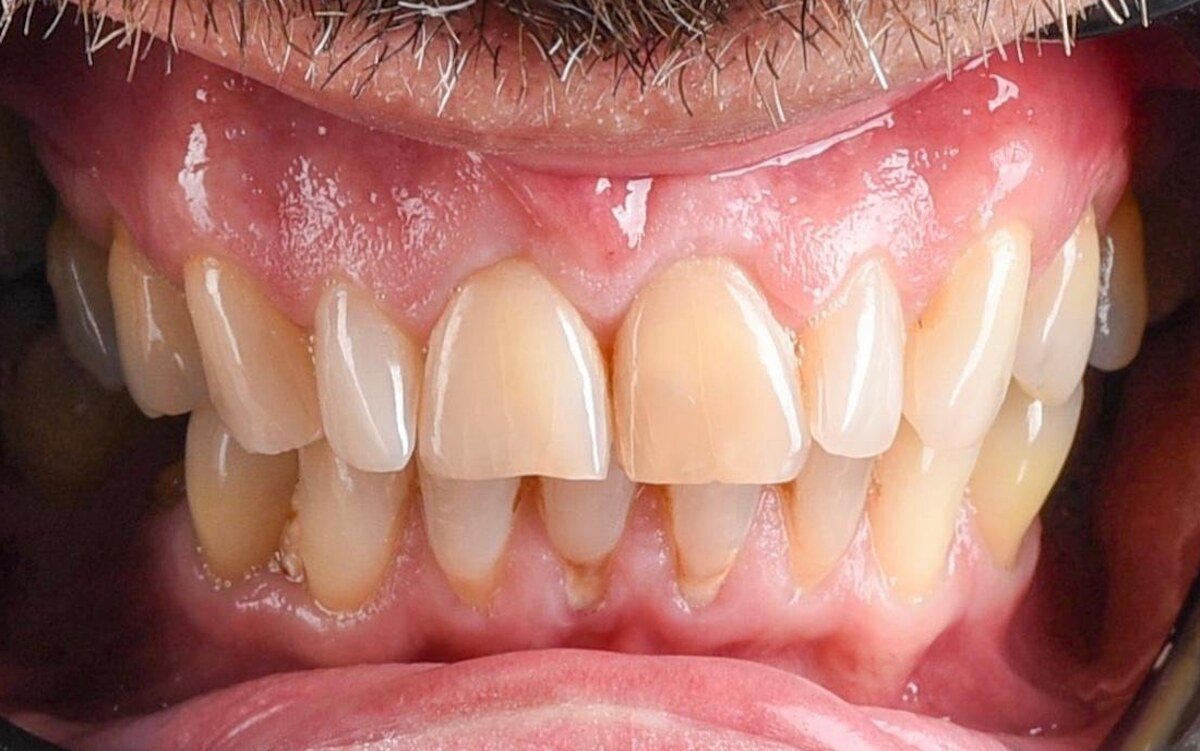
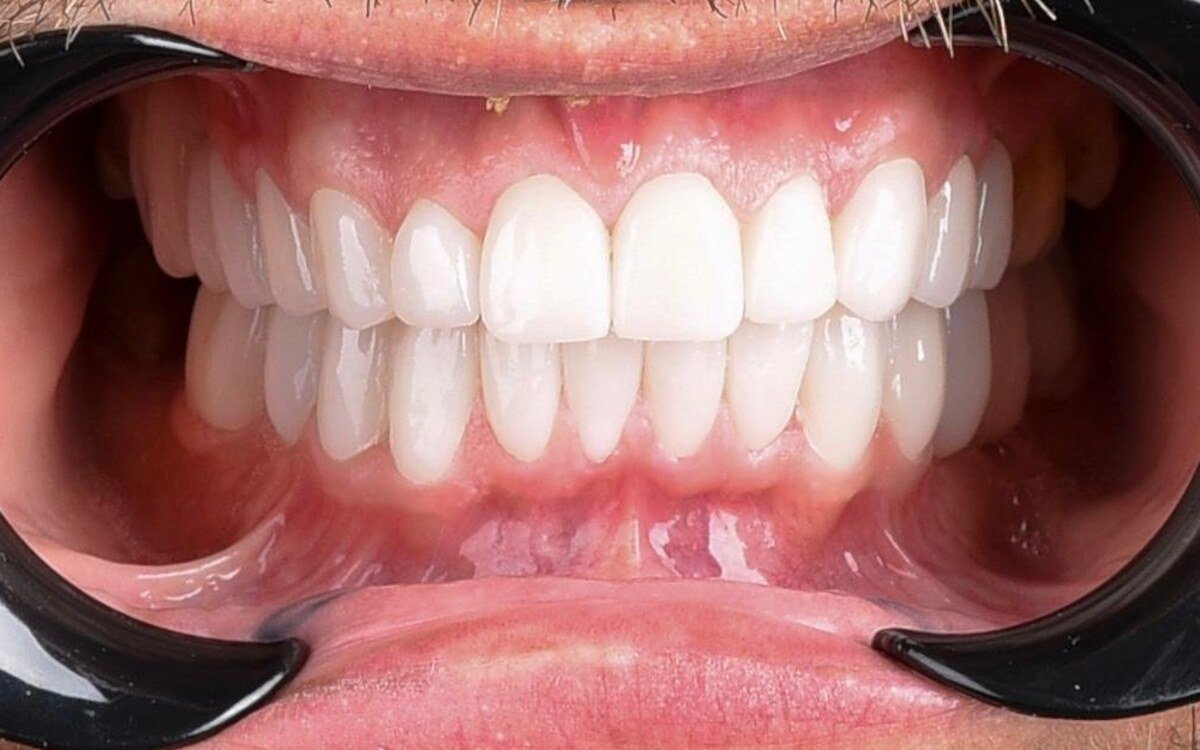
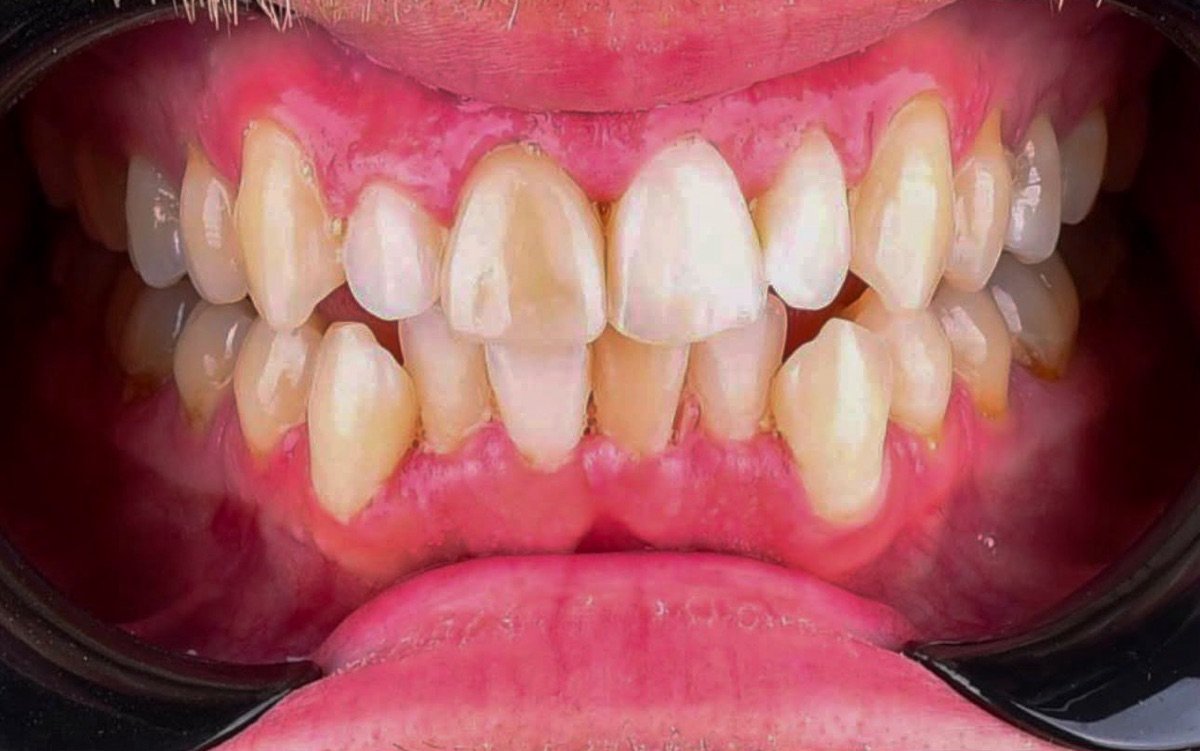
Before treatment the upper arch did not read as one colour: the two central incisors were noticeably lighter than the teeth beside them, which had darkened towards yellow-brown. The lateral incisors sat rotated and set back behind the centrals, the incisal edges stepped up and down instead of following a line, and the gum margin above the front teeth was red and swollen. The lower front teeth were crowded and overlapping, with a darker shade and an uneven edge line of their own.
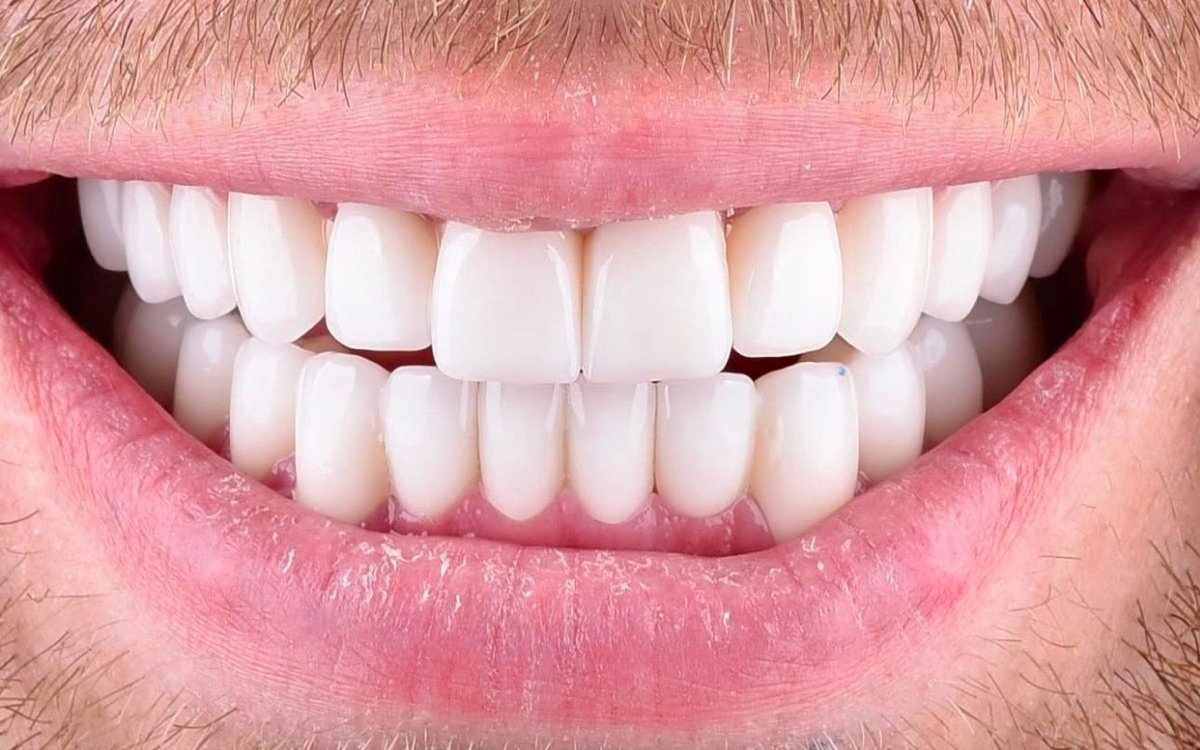
After treatment both arches read as a single shade from one side to the other, the upper front teeth follow one incisal line instead of stepping, and the teeth sit along the arch rather than rotated behind one another. The after photograph is a natural smile rather than a retracted view, so the two images are not framed the same way: the gum line you can see in the first photograph is largely covered by the lip in the second.
 Before
 After
After
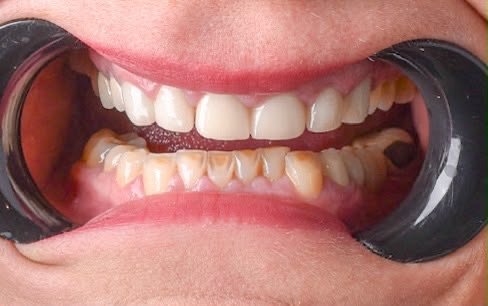
The lower front teeth had discoloured to a deep brown along the gum line, and their edges had worn down into an irregular line. The upper teeth were paler but no longer matched them, so the two arches read as two different colours whenever the mouth opened.
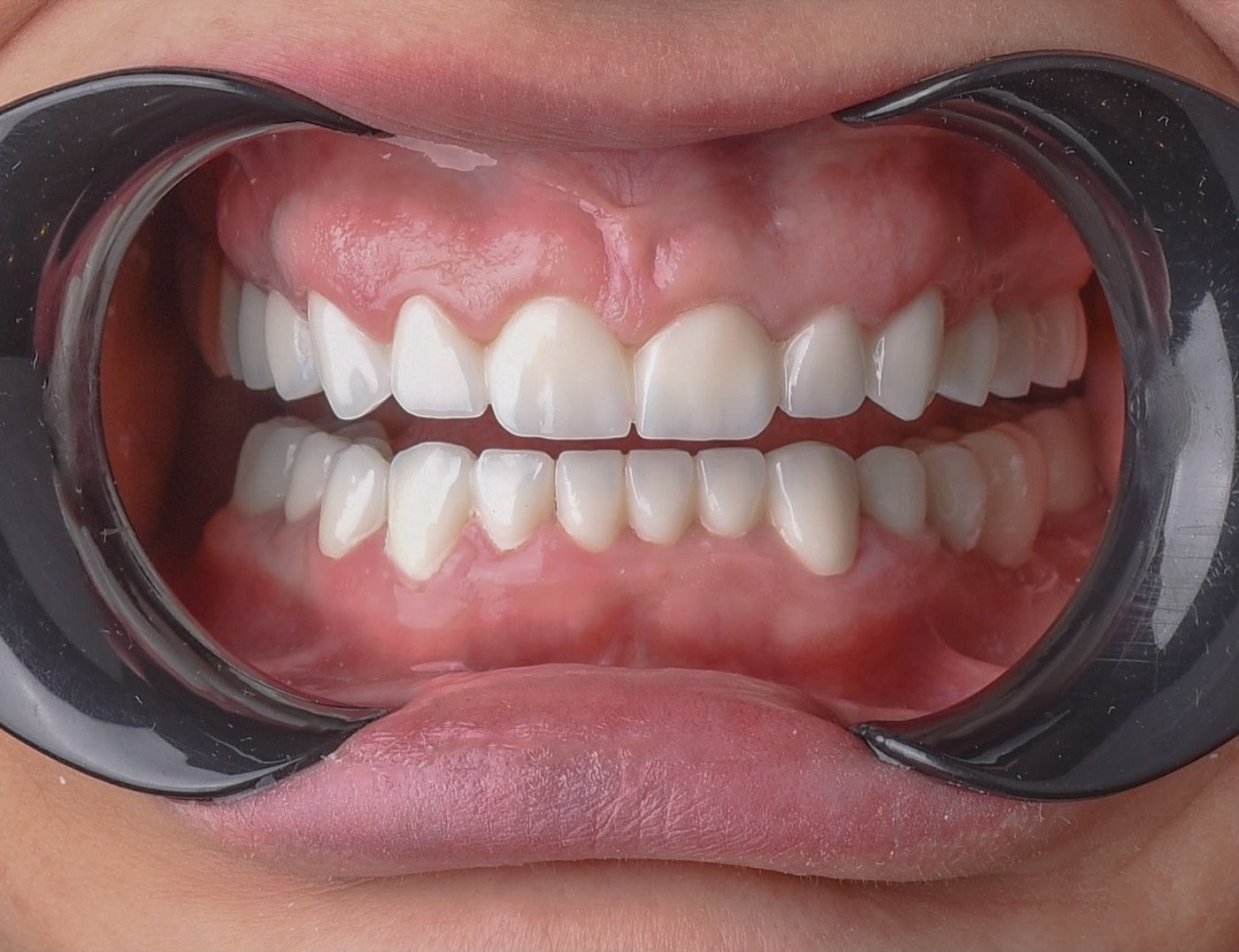
Both arches were brought to a single shade and the edges back to an even line. In the second photograph the gum margins sit cleanly against the restorations. Both images are retracted views, so what changed can be compared directly.
 Before
 After
After
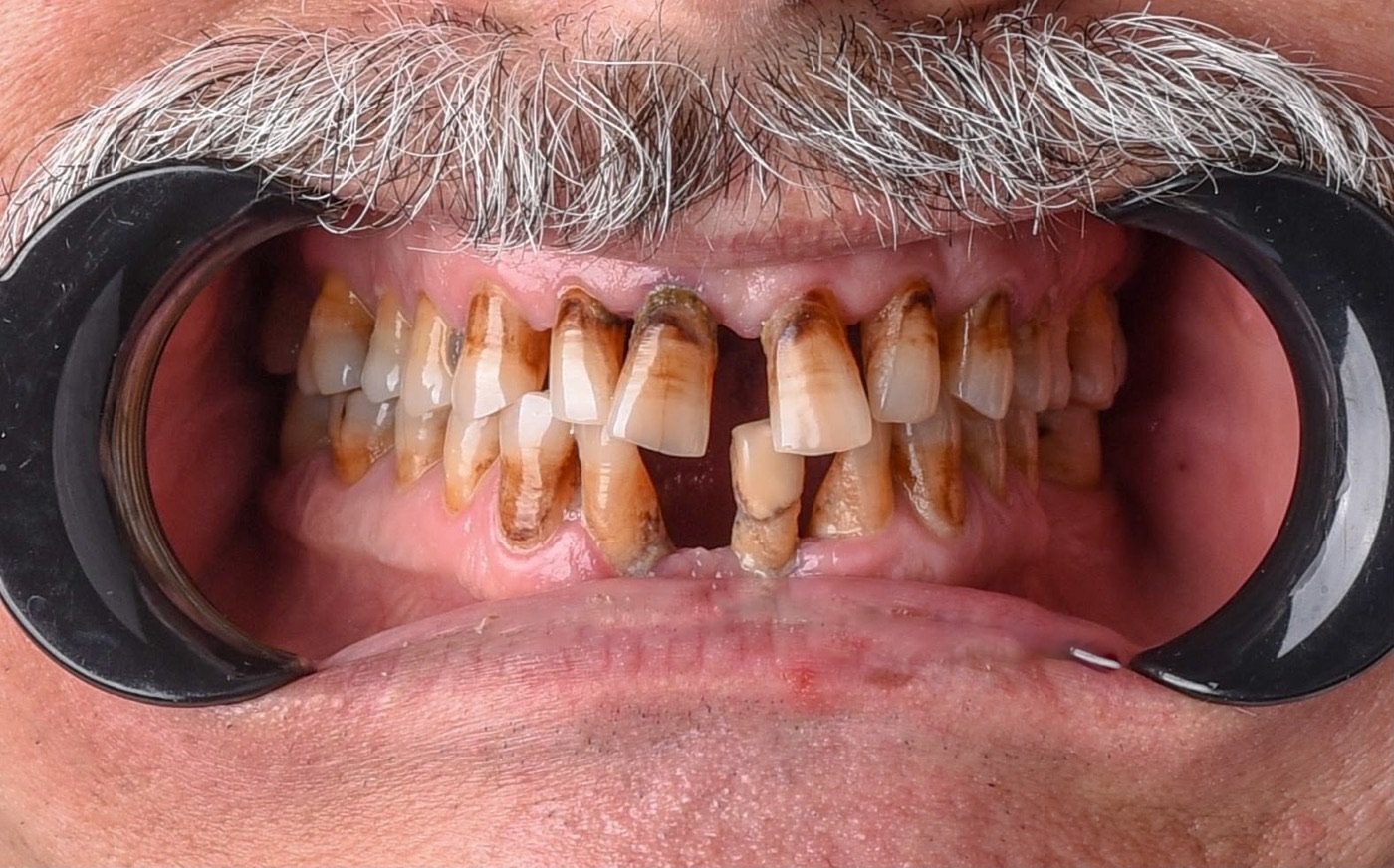
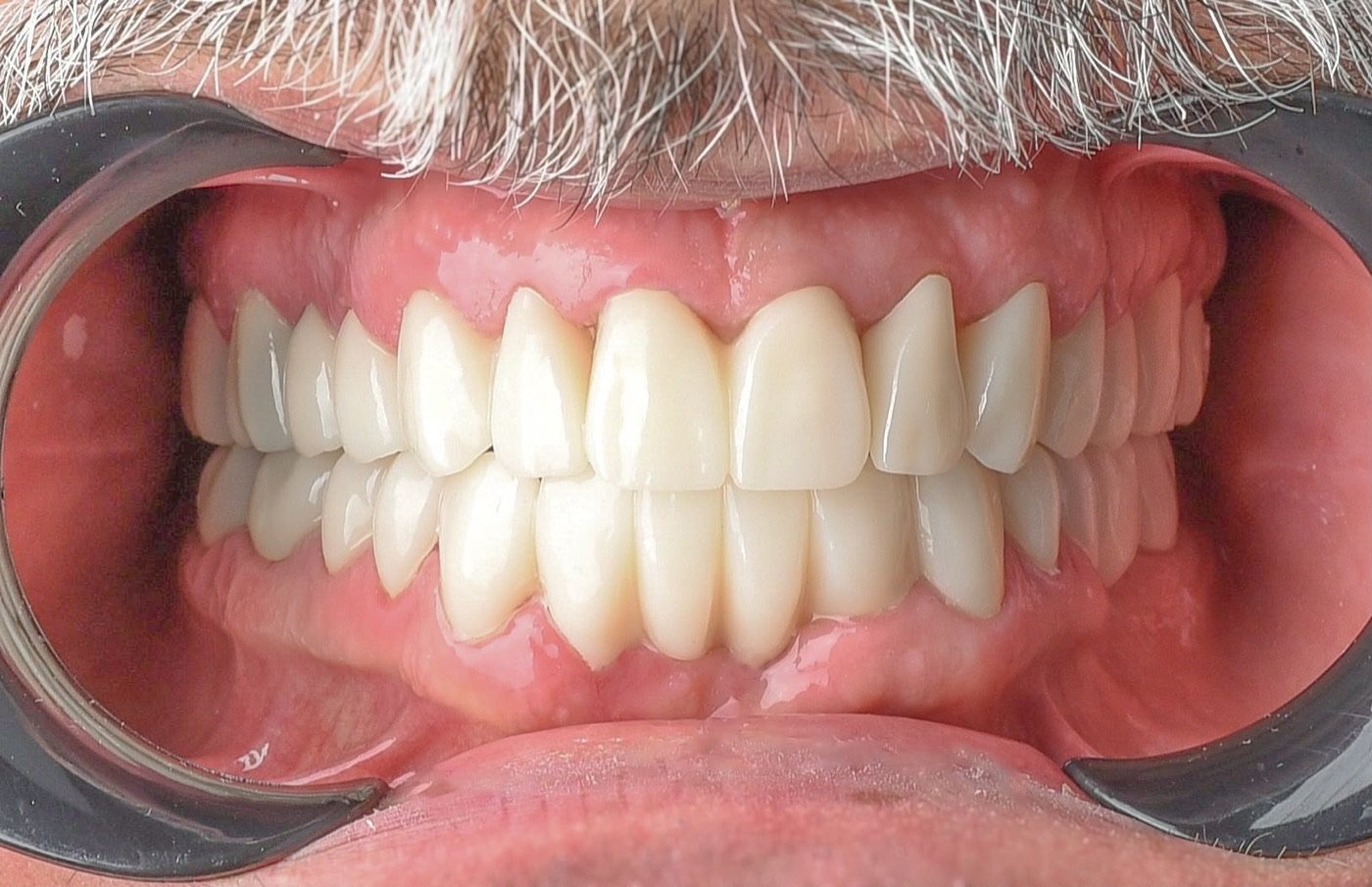
This is the most advanced case on the page. Nearly every visible surface was affected: the teeth were stained dark brown, worn short and irregular, gaps had opened between the front teeth, and the gum had receded far enough to expose root surface on several of them.
Both arches were rebuilt. The photograph after treatment shows an even edge line, one consistent shade across both arches, and gum margins settled against the restorations. Both images are retracted views taken the same way.
The part worth knowing is what was not done. A mouth in this state looks like a candidate for clearing and starting again, and it would have been quoted that way in plenty of places. In the event, one tooth was extracted and one tooth needed root canal treatment. Everything else was kept. Natural roots hold bone in a way that nothing replacing them does, and a tooth that can be saved is worth more than the tidiest possible plan.
 Before
 After
After
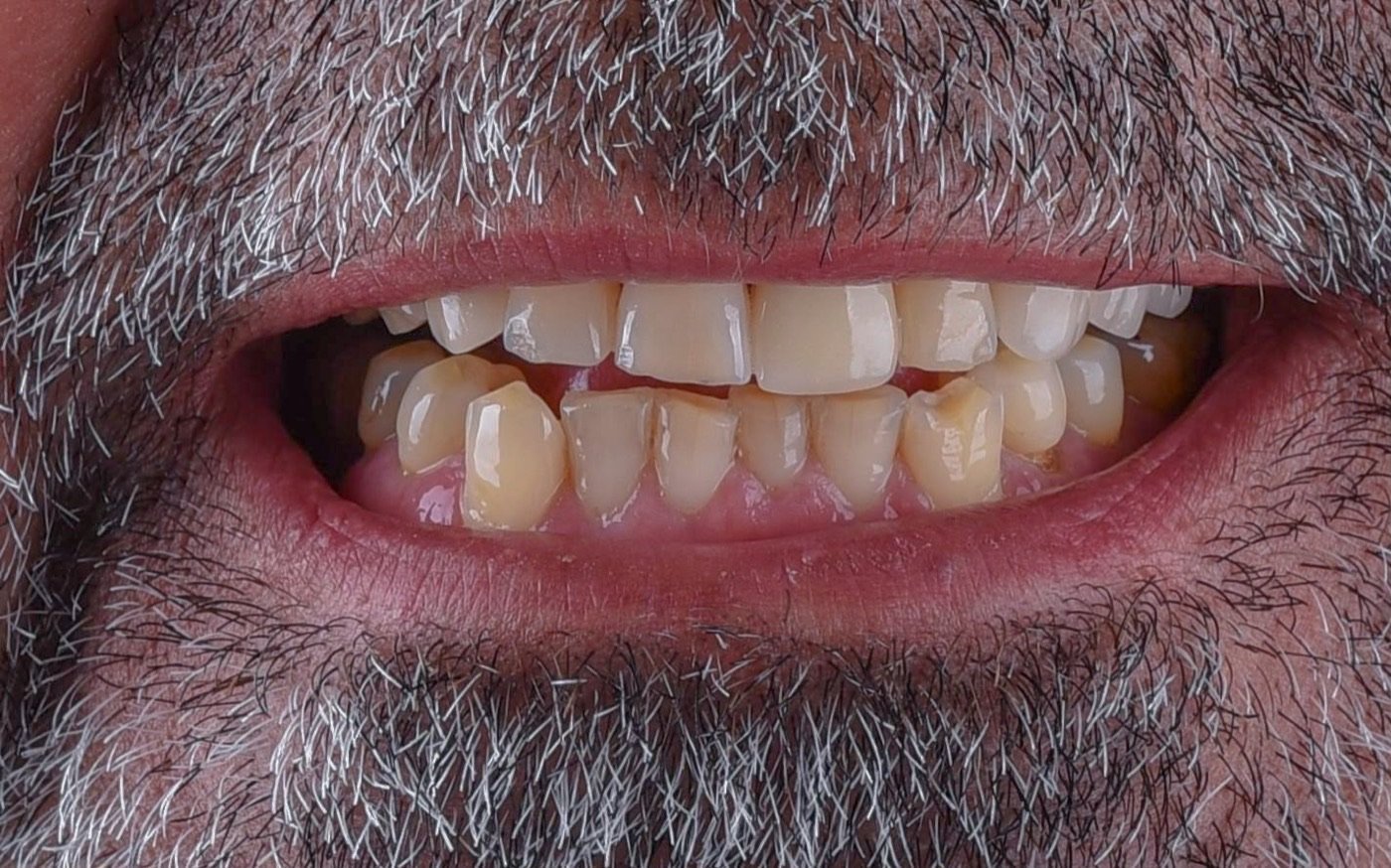
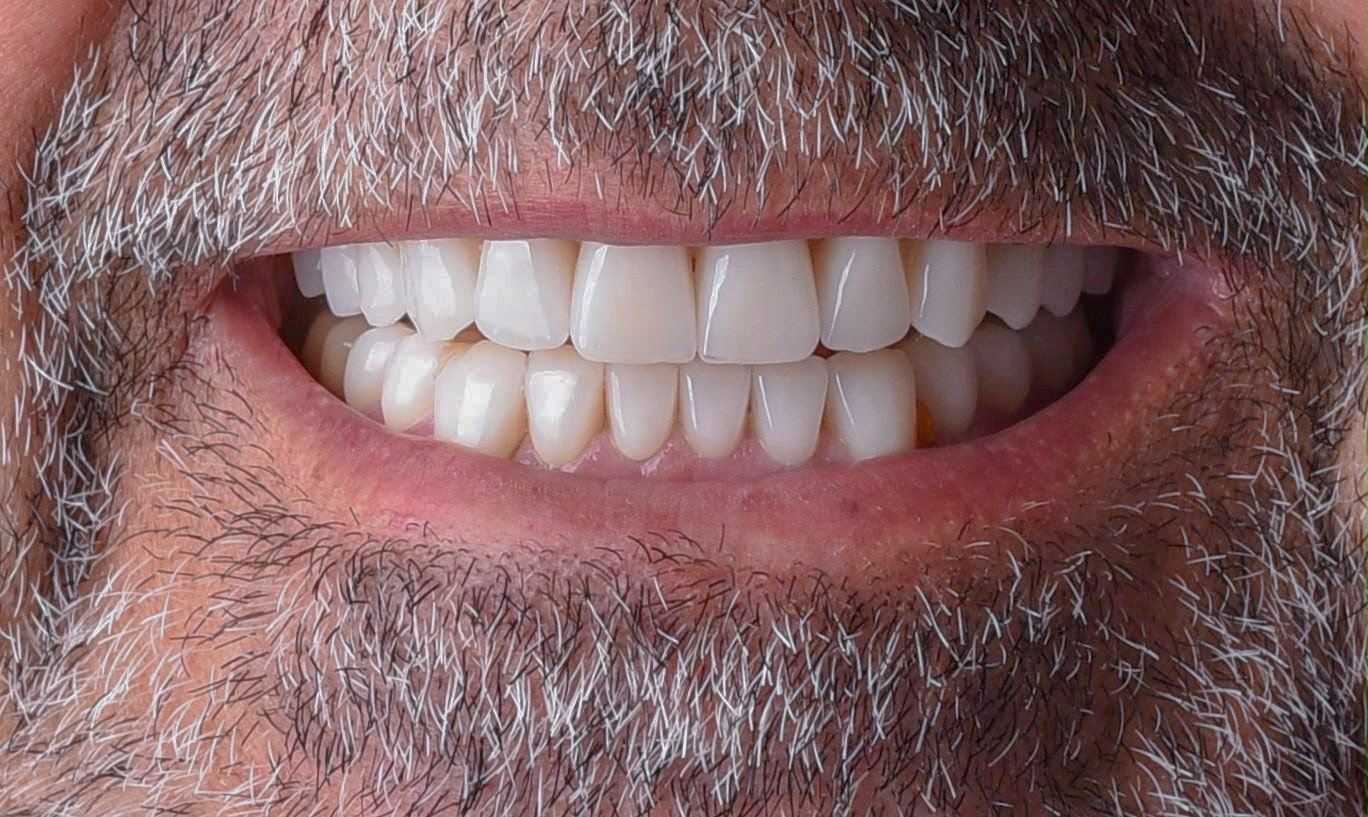
The upper front teeth had yellowed and their edges were chipped and uneven, so the smile line stepped up and down rather than following the lower lip. The lower front teeth were crowded and overlapping, and their gum levels sat at visibly different heights from one tooth to the next.
That last point drove the sequence. The gum line at the lower front teeth was levelled before any ceramic was fitted, because ceramic finished against an uneven gum margin locks that unevenness in permanently — and no amount of good laboratory work hides it afterwards. It is the sort of detail nobody consciously notices in a smile, and the reason a result can look subtly untidy even when every tooth has been corrected.
Two materials were used, chosen by position. The front teeth are lithium disilicate, which passes light the way enamel does and is what makes a front tooth read as a tooth rather than a chip of white. The back teeth are zirconia, which is considerably stronger under chewing load, and where optical subtlety matters much less than durability. One material throughout would have meant accepting a compromise at one end of the mouth or the other.
Both photographs are natural smiles taken from the same angle, so this is a like-for-like comparison.
 Before
 After
After
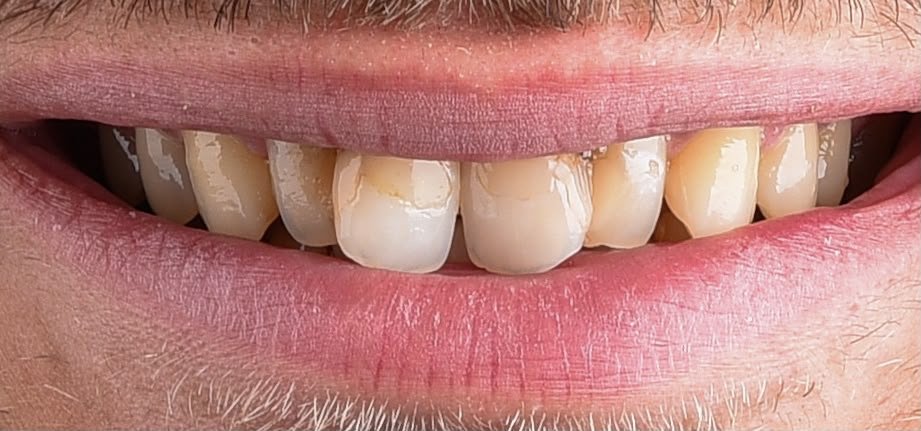
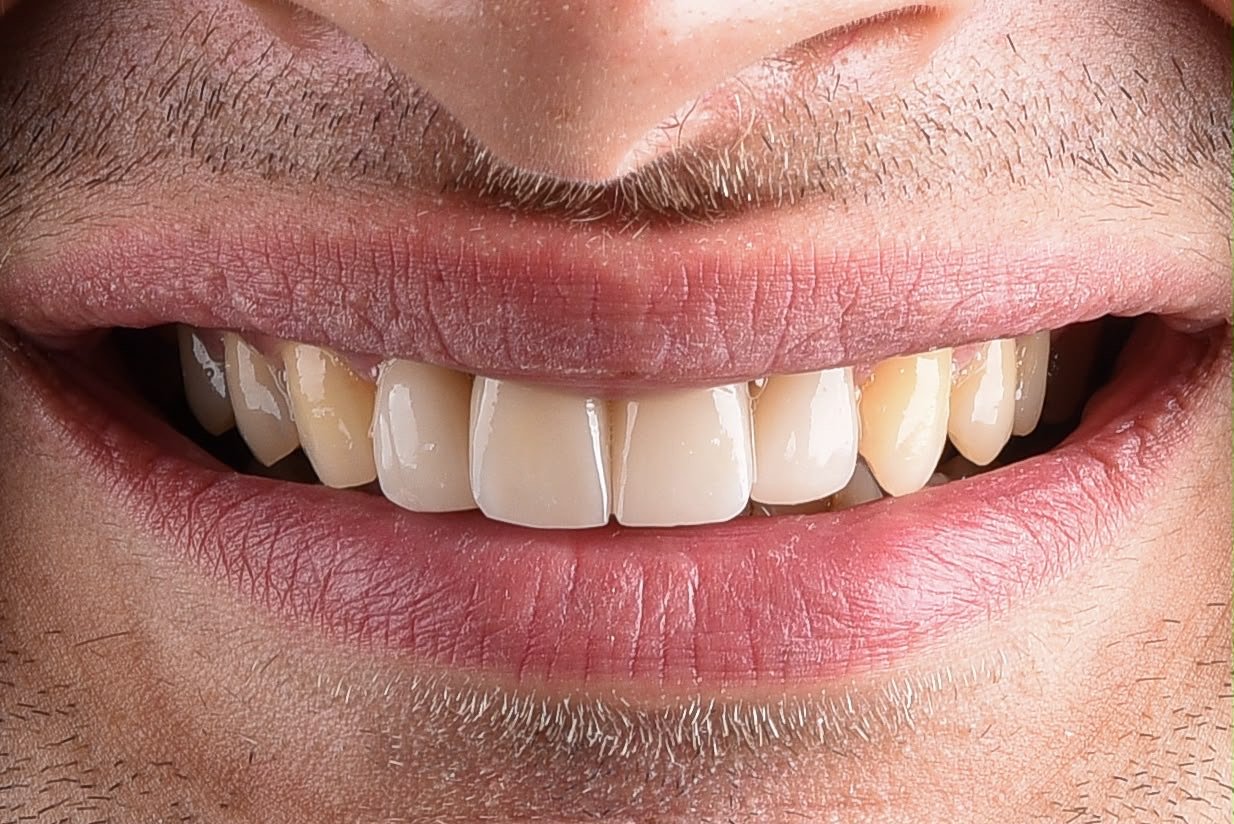
This was, honestly, a borderline case for veneers, and it is worth saying so. It reached us as a referral from an orthodontist, and the patient is young — which changes the calculation entirely. Enamel does not grow back. Someone this age will carry whatever is done here for decades and will need it renewed at least once in that time, so every fraction of a millimetre left in place now is an option kept open later.
Before treatment, one of the upper central incisors was an older restoration in an opaque shade that matched nothing around it and had stained along the gum line. The teeth beside it had yellowed unevenly, and the edges no longer followed a single line.
That made the brief a narrow one: correct four front teeth with the least preparation the case would tolerate, and match the result to the patient’s own teeth rather than to an idea of white. The restorations are lithium disilicate, which keeps its strength in thin sections and passes light the way enamel does — it is the material that makes minimal preparation viable at all. We took that as far as it goes.
Which is why the canines and the teeth behind them still carry their natural, warmer colour, and why you can see a step in shade where the work ends. That step is the intended result, not a compromise: making this mouth read as one uniform white would have meant cutting far more tooth than a patient this age should have cut. Both photographs are natural smiles.
 Before
 After
After
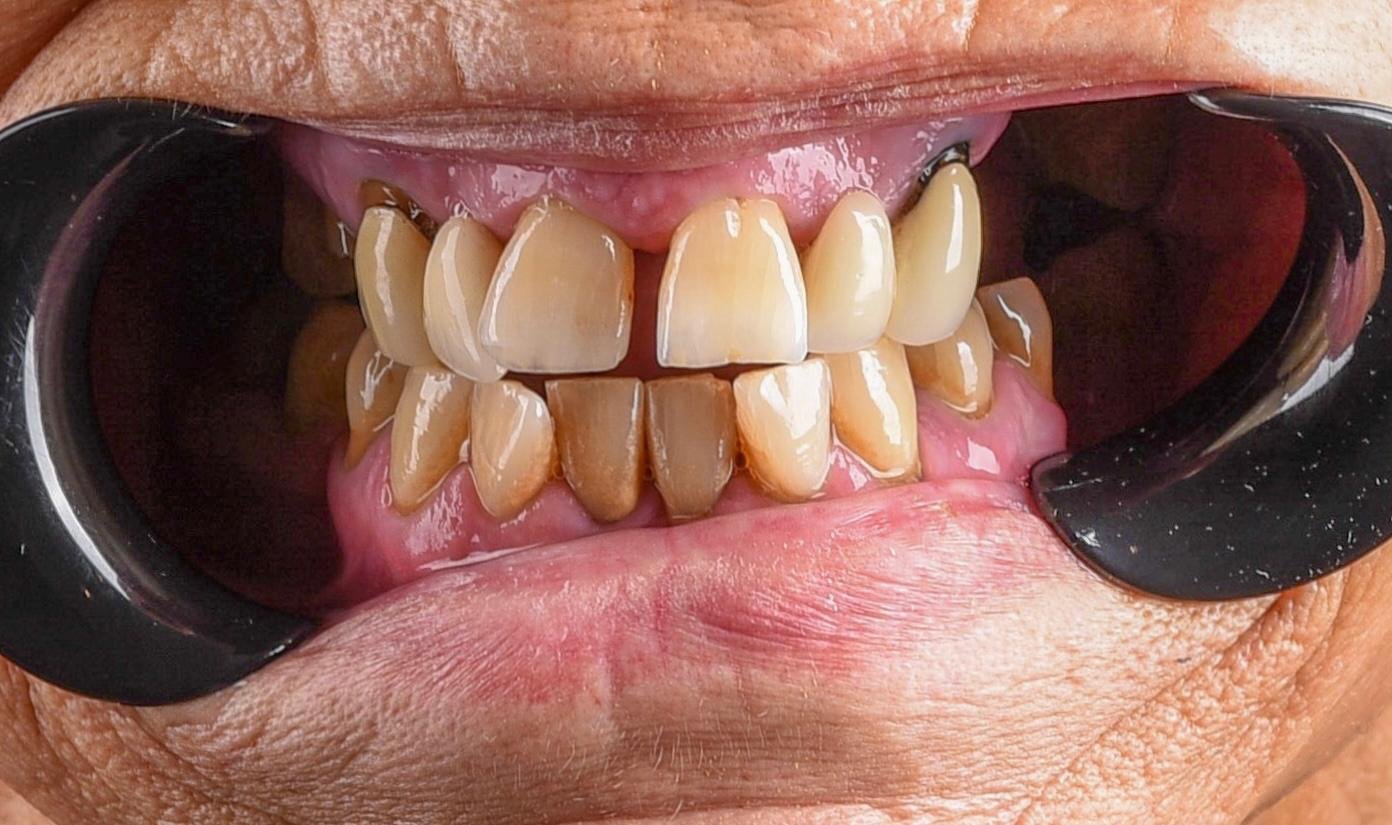
This patient is older and had been missing back teeth for years — more common than it sounds, and more consequential than it looks. When the back teeth go, the front teeth start doing a job they were never shaped for. They carry the whole load of chewing, they wear down, and as they shorten the distance between the jaws closes with them. The first photograph is where that ends: upper and lower front teeth meeting almost edge to edge, worn flat and shortened unevenly, and empty space behind them on both sides.
The temptation with a mouth like this is to treat what shows. Crowns on the front teeth would have photographed well and solved nothing, because the reason those teeth were worn out is that nothing behind them was sharing the work. New ceramic on the front of a collapsed bite wears out too — faster, and more expensively.
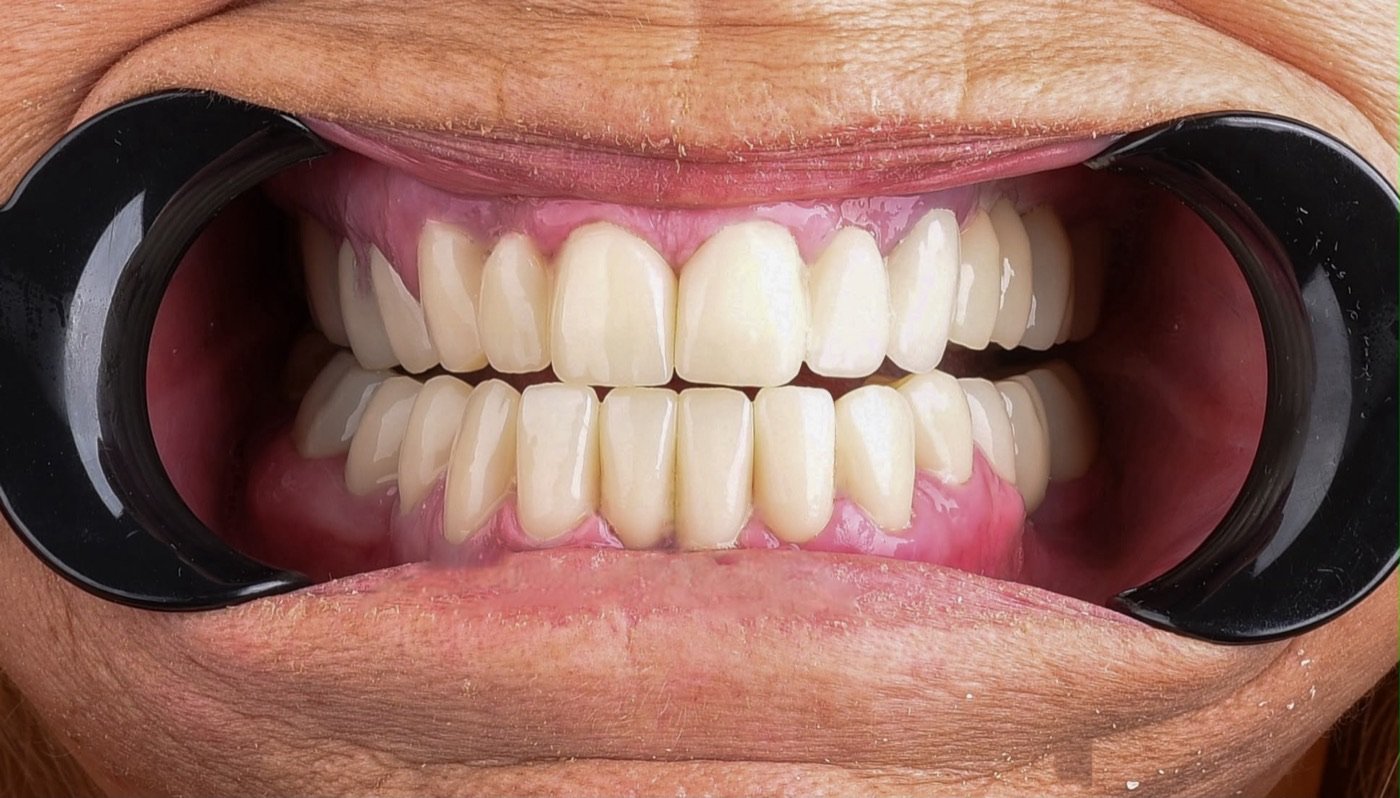
So the sequence ran the other way round. The back teeth were restored first, which is what re-establishes contact between the arches and gives the jaw relationship back to the muscles and joints that have to live with it. Only once the bite was being carried at the back were the front teeth rebuilt, to a length that belongs to the restored jaw relationship rather than the collapsed one.
The result is easier to eat with than it is to photograph, and that is the right way round. Appearance follows a mouth that works; it does not substitute for one. At this patient’s age the difference between a bite that functions and one that merely looks tidy is the difference between eating properly for the next fifteen years and not. Both photographs are retracted views taken the same way, so the change is directly comparable.
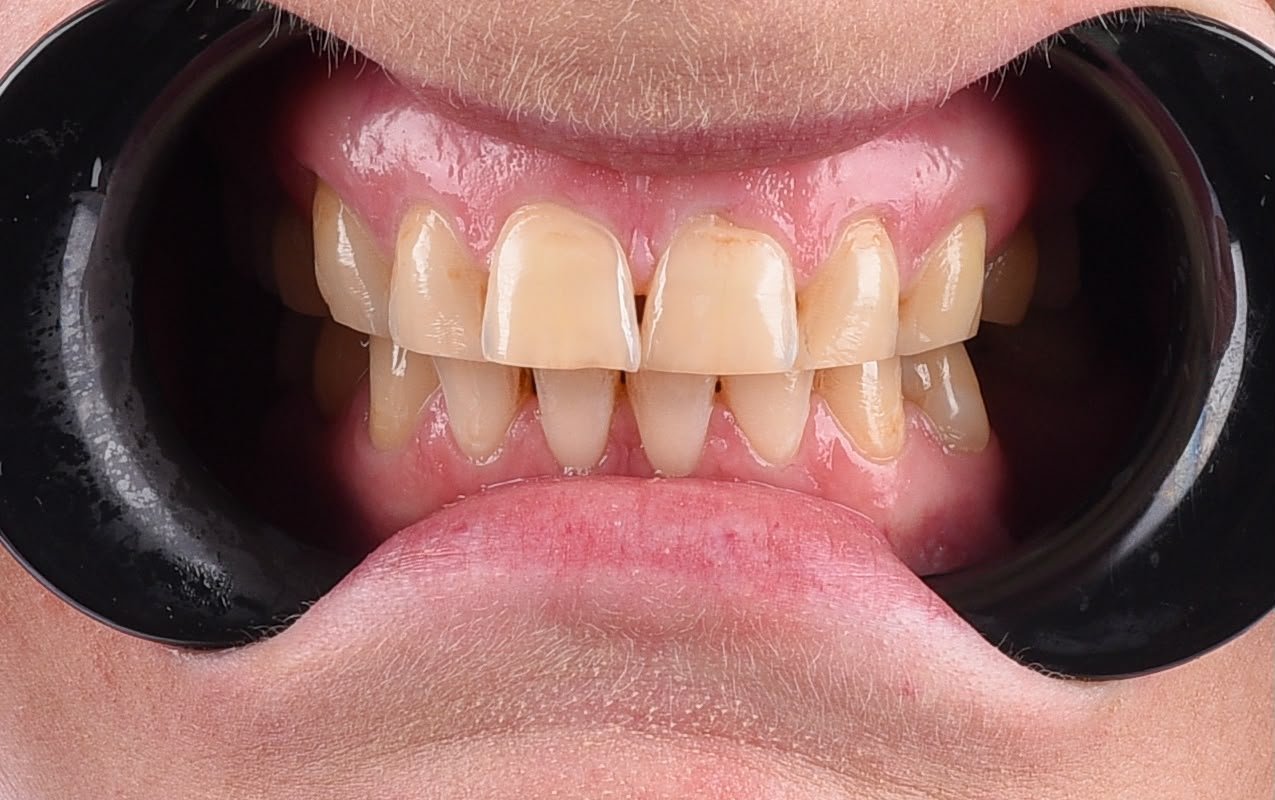 Before
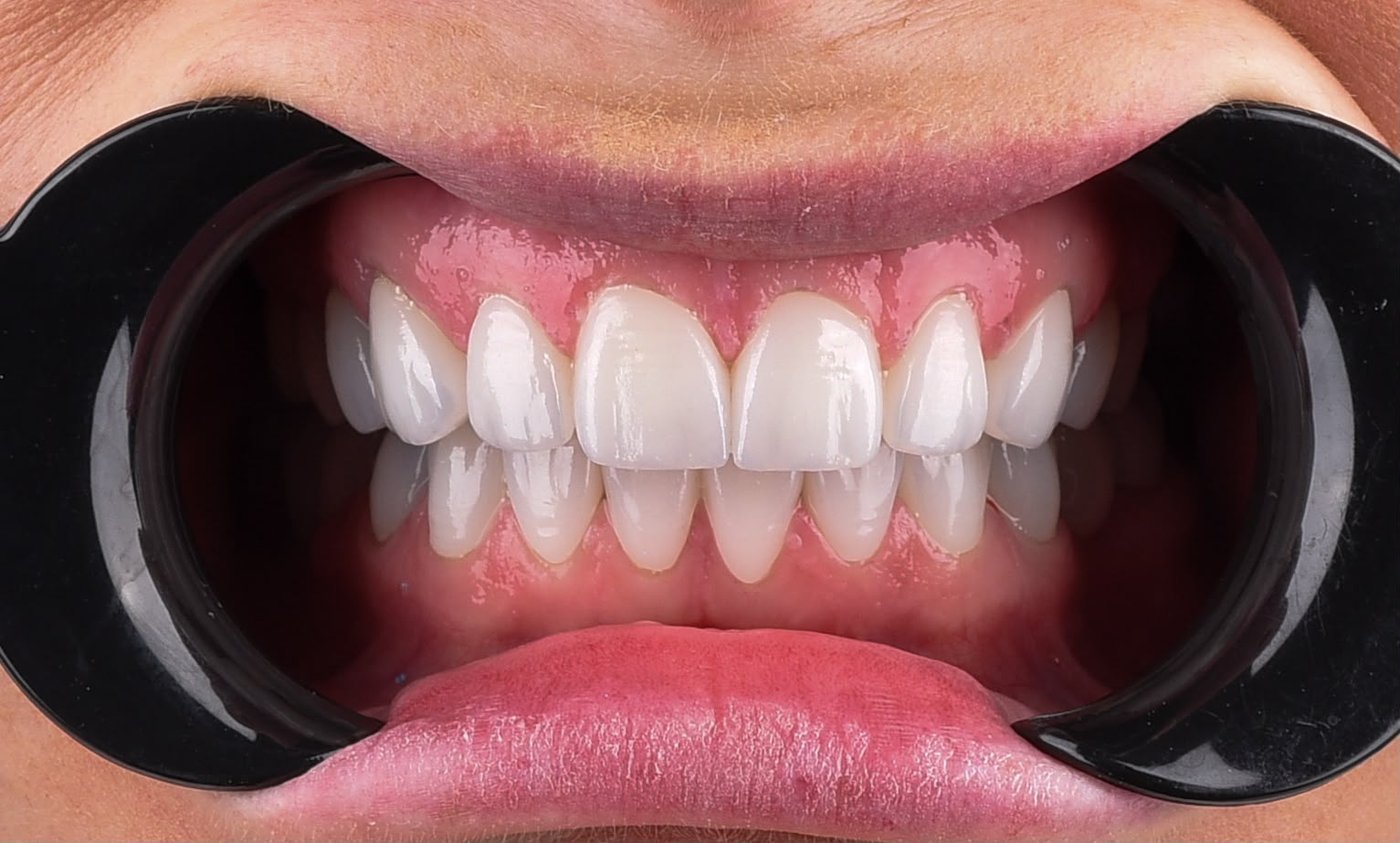 After
After
Three things were wrong at once, and fixing any one of them on its own would have left the other two looking worse. The teeth had darkened to a deep yellow across both arches, with brown staining collecting along the gum line and in the spaces between them. The upper central incisors had a small gap between them, and the lower front teeth had small gaps of their own. And the edges were worn: the upper front teeth no longer finished on one line, and the lower ones had been ground flat.
Whitening would have lightened the colour and left the gaps and the worn edges exactly where they were. Staining this deep, much of it at the gum line, also rarely lightens evenly. Closing the gaps with bonding alone would have meant adding material to teeth that were already the wrong length and shape. So the work was planned as one restoration of both arches. Shape, length, spacing and colour were decided together, across every tooth that shows when this patient talks and smiles, upper and lower.
The result is a light shade, and that deserves a sentence of its own. How light is something we decide with the patient before anything is bonded, and it is the one decision in a case like this that cannot be cheaply reversed afterwards.
This case was photographed three ways: teeth together with cheek retractors, teeth slightly apart, and a natural smile. Each before and after was taken the same way, so every pair can be compared directly.
Photographed at the clinic and published with each patient’s written consent. Every mouth is different: what is achievable for you depends on your bone, gums, bite and starting shade, and can only be established after an examination. These images show what these patients achieved — they are not a promise of your result.
The team
Two dentists rather than an anonymous "expert team". One places the implants, the other designs what goes on top — both named, with training and publications you can check before you decide anything.
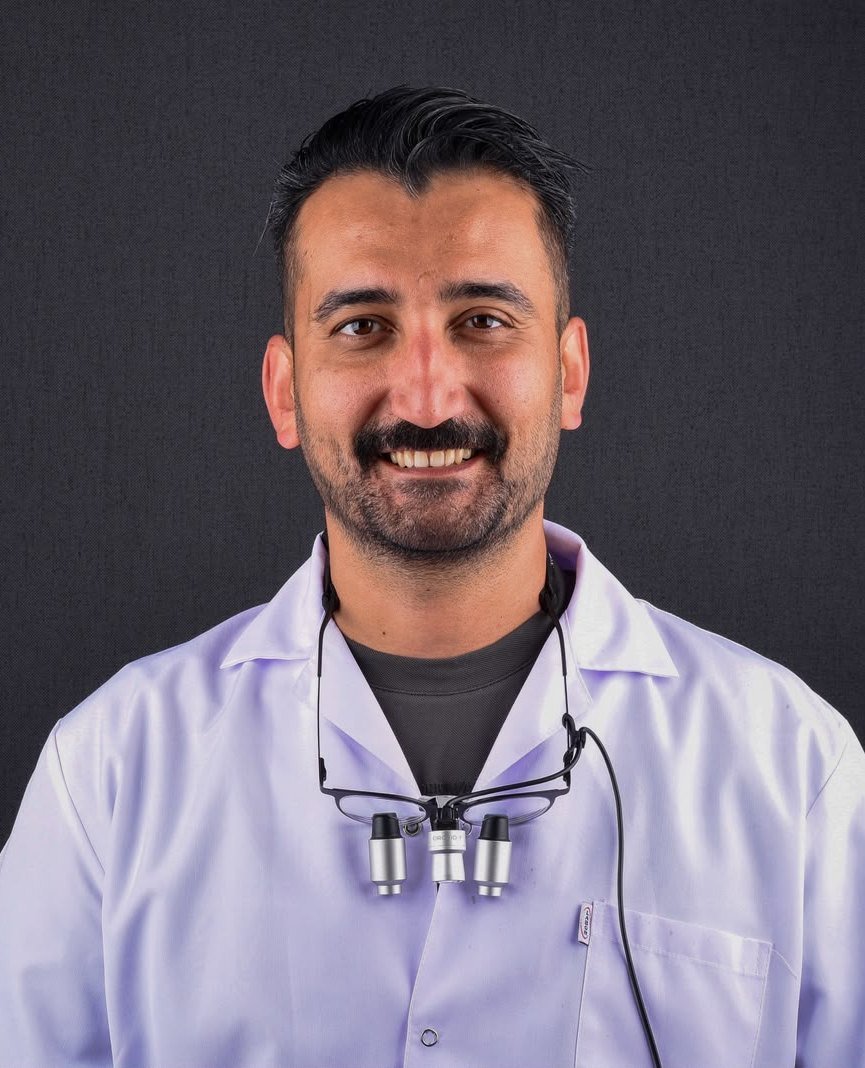
Founding dentist · Prosthodontics, doctorate
He treats across the full range of dentistry, from a single filling to full-arch rehabilitation. His doctorate is in prosthodontics — the discipline that rebuilds teeth which are worn, broken or missing, and that decides how the rebuilt bite will behave over the following decades. Almost every case shown on this site ends in it.
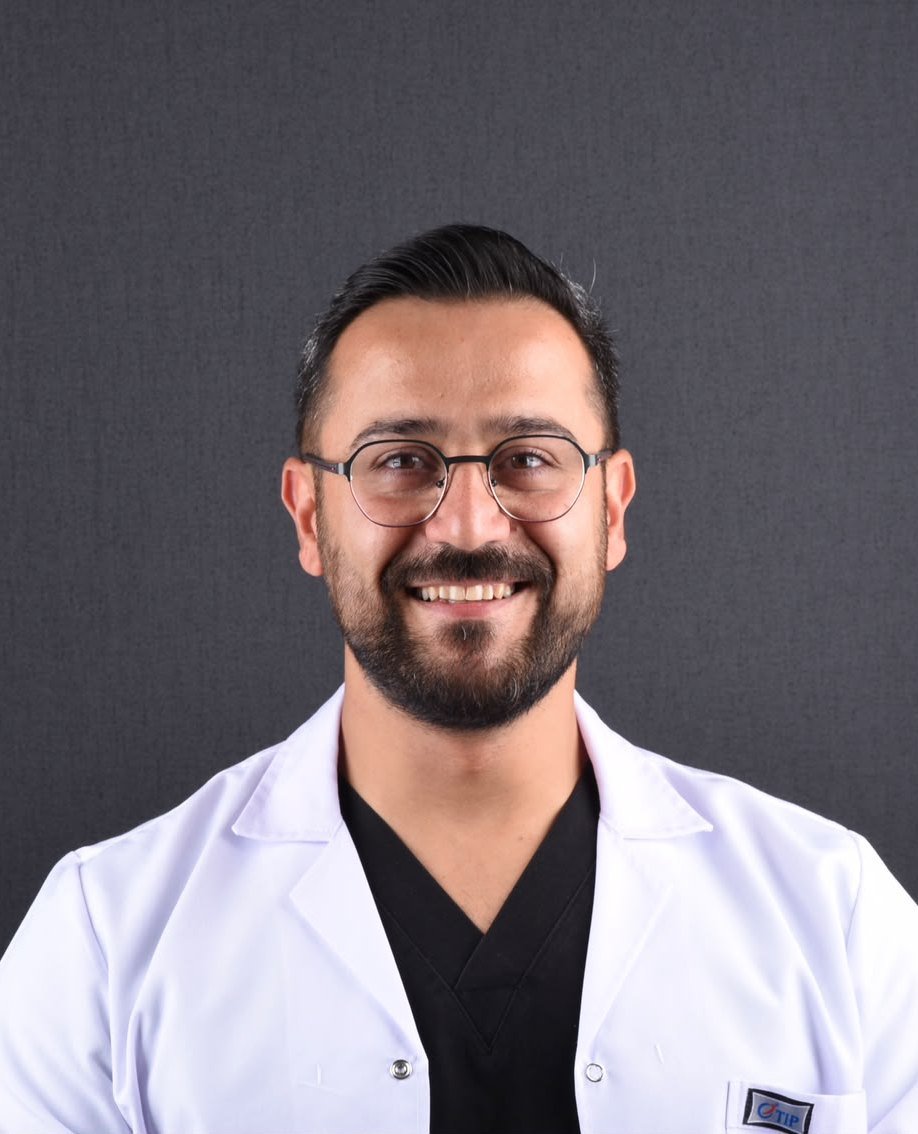
Dentist · Implant surgery and prosthetics
Implantology is the surgical half of most of the work shown on this site: judging whether bone will hold an implant, putting it where the finished tooth needs it rather than where it is easiest to place, and saying so when the honest answer is that it will not work.
The clinic
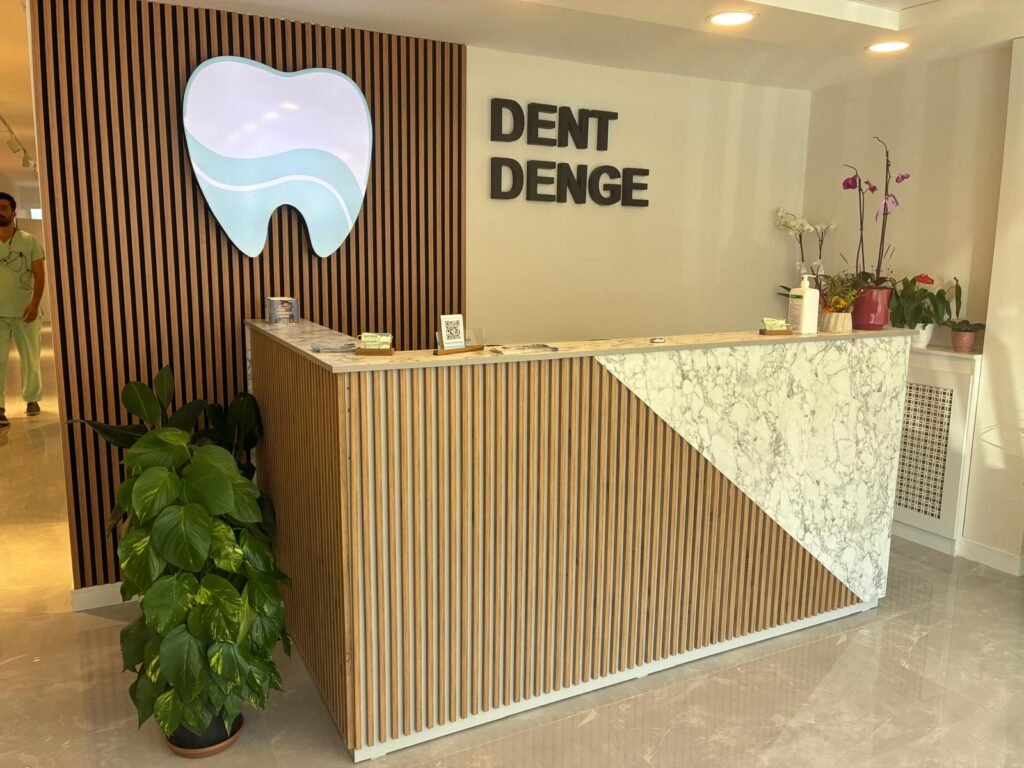
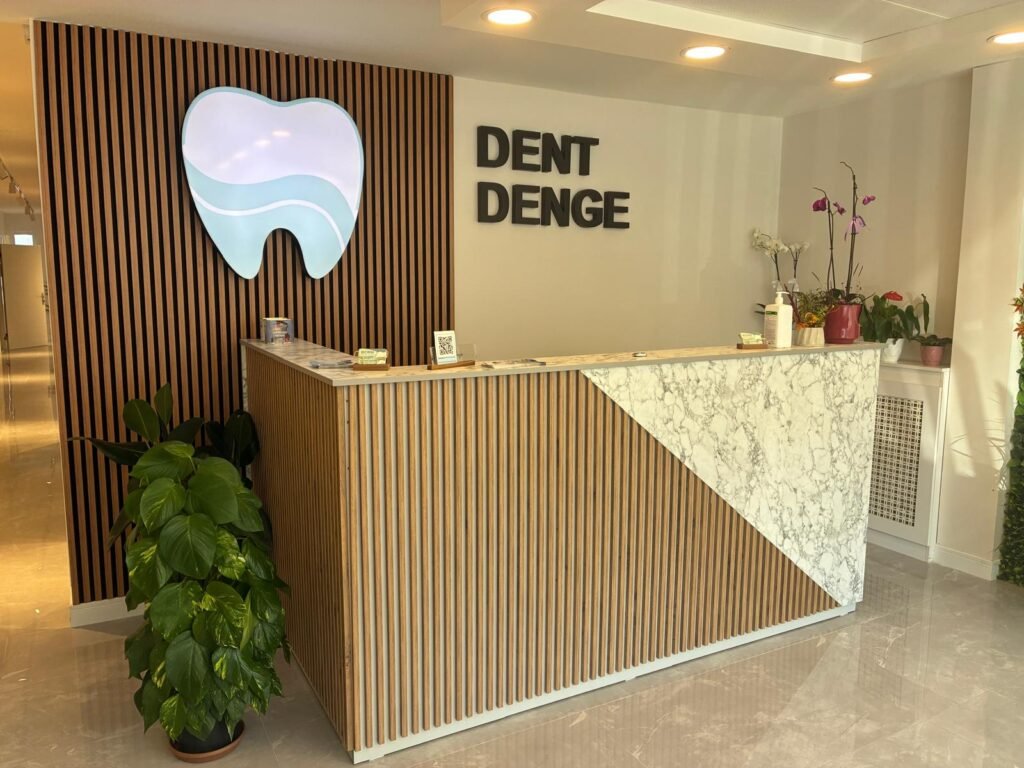
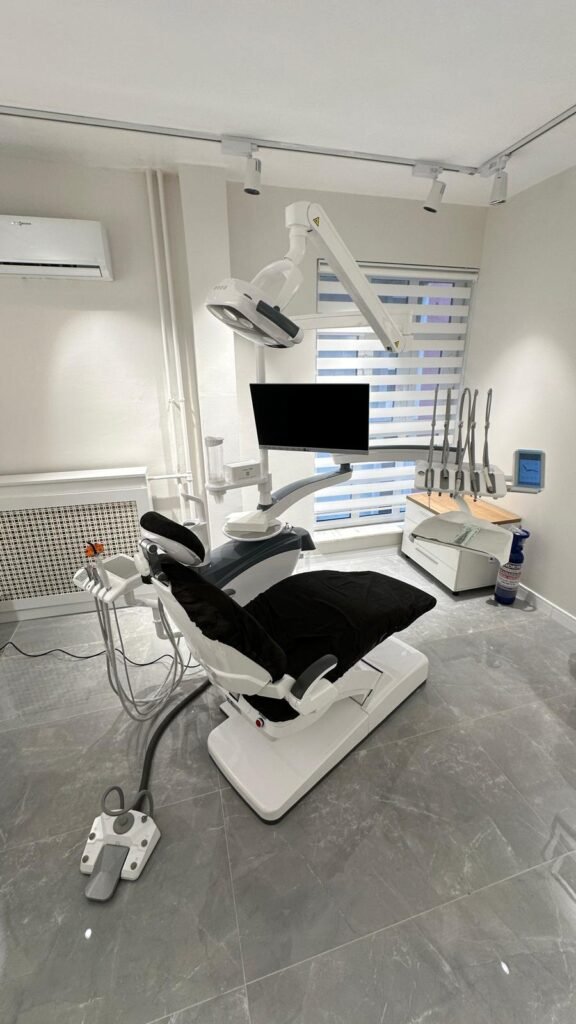
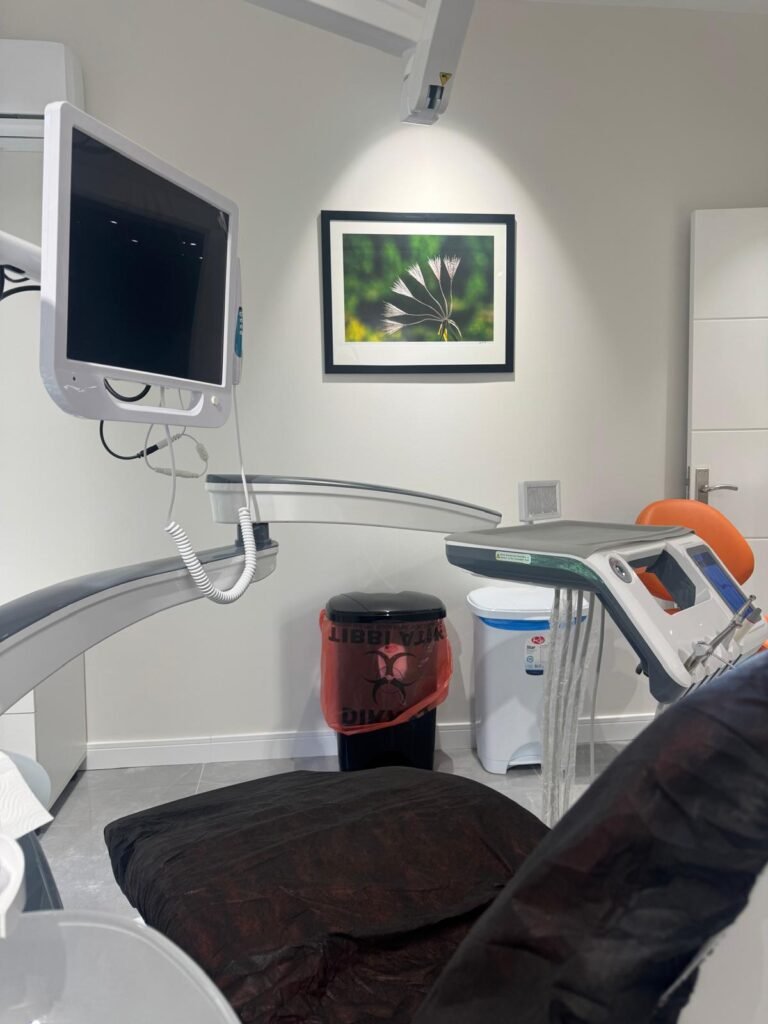
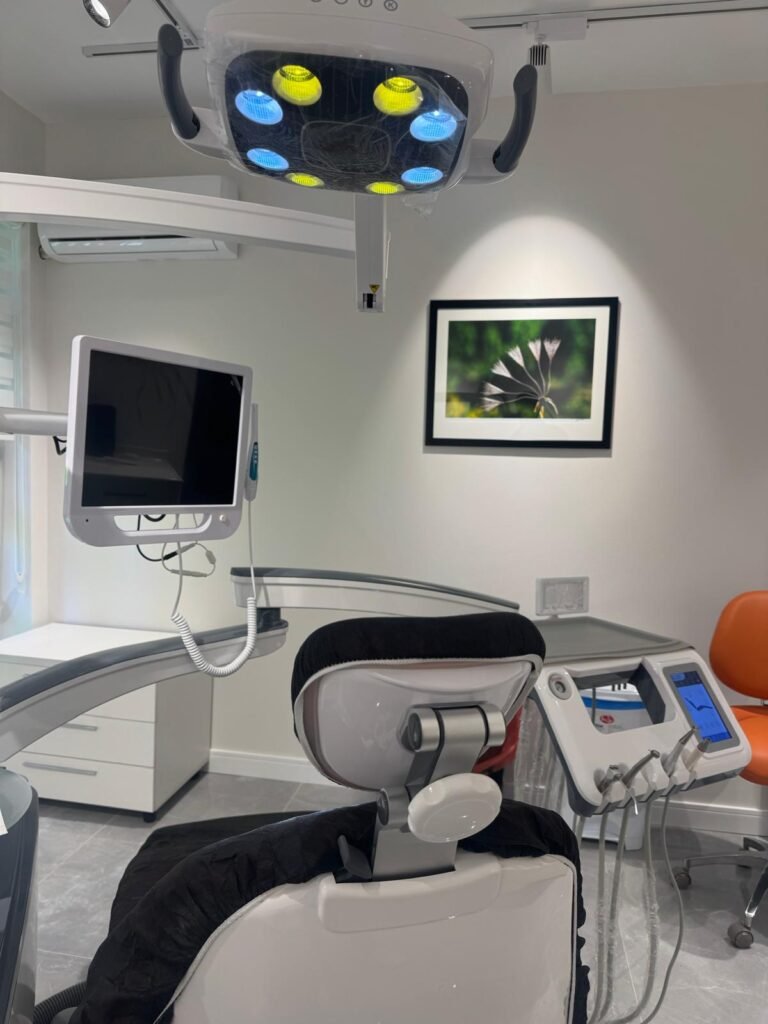
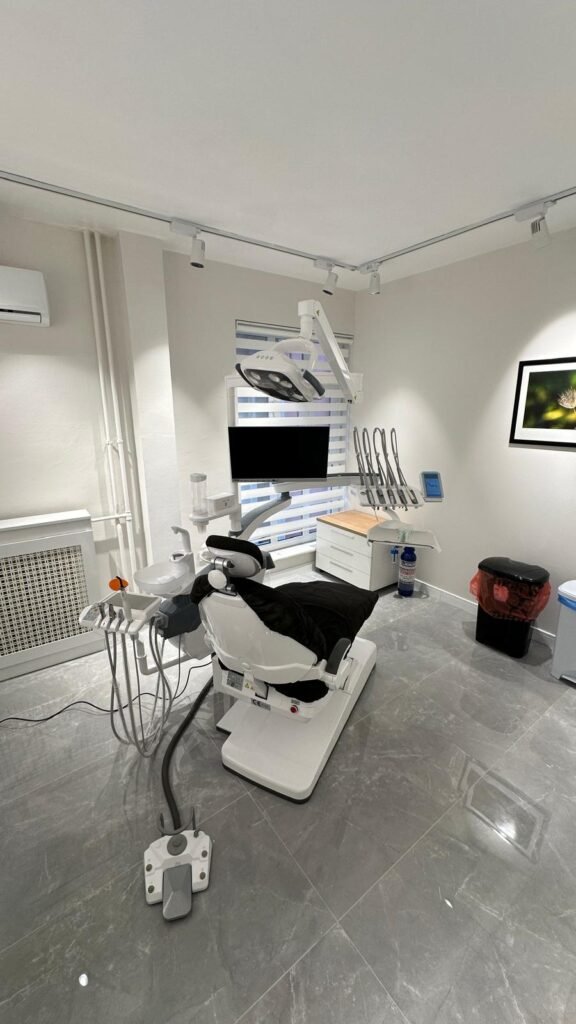
Not a stock library. These are the rooms you will actually sit in, in Çankaya, Ankara, photographed on an ordinary working day.
Standards
Dental tourism is often sold on price alone. These are the details that actually determine whether you are still happy with the work in fifteen years.
No treatment plan is issued without imaging. A quote produced from a smiling photograph is a sales estimate, not a clinical plan, and it changes once you are in the chair.
Implant system, diameter, length and lot number are recorded and given to you. Ceramic brands and shades are documented so any dentist can match or service the work later.
We prepare through an approved mock-up so removal follows the design. Where whitening and bonding achieve the goal, we recommend them instead of veneers.
Loupes for restorative work and an operating microscope for endodontics. Most root canal failures are caused by a canal that was never seen.
Surgery, laboratory work, imaging, follow-up and any grafting appear in a single quote before you travel. Additions in the chair are how surprise invoices happen.
Plans, risks, alternatives and aftercare are provided in English or German. Informed consent given in a language you do not speak is not informed consent.
How it works
Five steps, each one defined before it begins. You always know what happens next and what it costs.
01
Photographs of your smile, or a panoramic X-ray if you have one, by WhatsApp or e-mail. Tell us what bothers you and roughly when you could travel.
02
Within one working day: a written treatment plan, the alternatives considered, a day-by-day schedule and a fixed all-inclusive quote. No obligation.
03
We coordinate airport transfer and hotel, and set the appointment sequence around your flights. You book the flight; we handle everything on the ground.
04
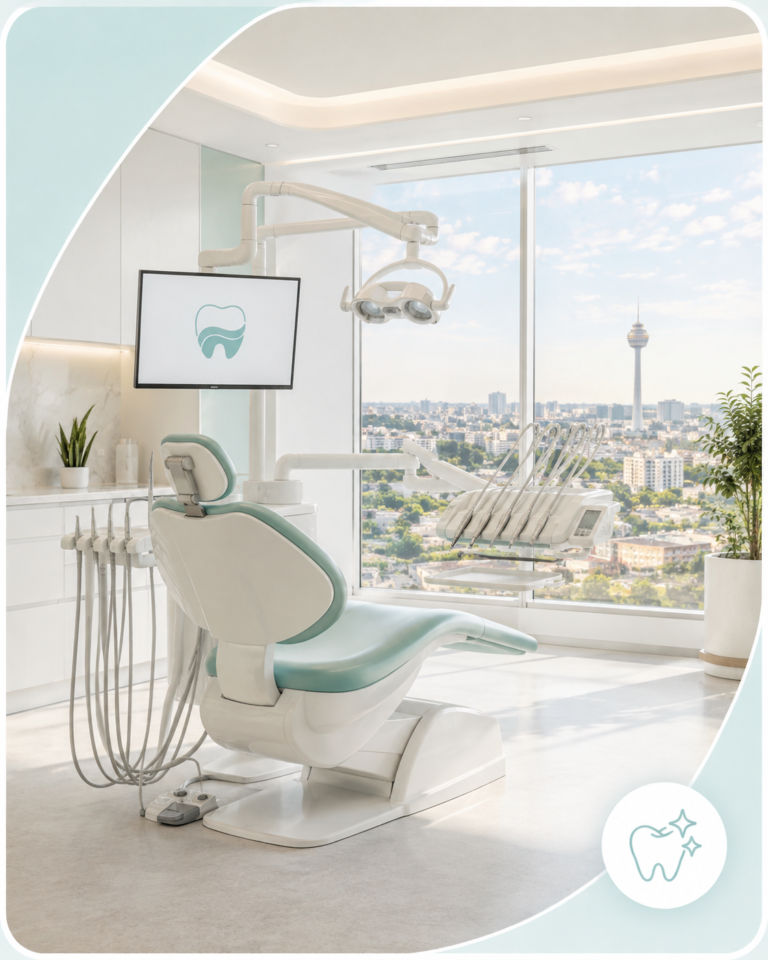
Day one is examination, 3D imaging and confirmation of the plan against live data. Treatment follows the agreed schedule, with reviews built in before you fly home.

05
You leave with records, an implant passport where relevant and a written maintenance protocol for your own dentist. Remote review stays open to you.
Ankara
Ankara is Türkiye's capital and its administrative and university centre — a working city rather than a holiday destination, with the specialist medical infrastructure that follows from that. Esenboğa Airport connects directly to most major European cities, and the clinic sits in Çankaya, the city's central district, close to hotels, embassies and the university quarter.
The practical difference is what surrounds the treatment. A city with universities and teaching hospitals has laboratories, specialists and imaging available at short notice — the things that matter when a case turns out to be more complex than the photographs suggested.
Guides
Türkiye licenses clinics that treat international patients. Most patients never hear about it, which is a shame, because it is the single most useful thing to check before you book.
Almost every dental tourism website points at Istanbul. Here is what that concentration costs you clinically, and what Ankara offers instead — including where Istanbul genuinely wins.
Nine things you can verify from your own kitchen table before you spend anything, and the specific answers that should end the conversation.
Before you ask
Send photographs of your teeth and, if you have one, a recent panoramic X-ray, by WhatsApp or through the contact form. Within one working day you receive a written treatment plan setting out what we propose, the alternatives, the number of days needed in Ankara and a fixed all-inclusive price. There is no charge and no obligation.
Yes, for everything set out in the plan. The quote covers surgery, laboratory work, imaging, materials and follow-up, and where a bone graft is likely it is priced in advance rather than added later. The only circumstance in which a plan changes is a clinical finding that could not be seen on the records you sent — and in that case we discuss it and re-quote before proceeding, never during a procedure.
It depends entirely on the treatment. Whitening or bonding needs one to two days. Veneers and crowns typically need five to eight. Implants are two trips of three to five and five to seven days, separated by three to four months of healing. Full-arch All-on-4 treatment is five to seven days, then seven to ten. Your written plan gives exact dates before you book flights.
Contact us first — most post-treatment questions are resolved by WhatsApp with a photograph. Where hands-on care is needed, your records, implant passport and treatment protocol let a dentist near you act quickly, and we will speak to them directly if that helps. Where a problem is attributable to our work, we arrange the remedy; the terms are set out in writing with your plan rather than left vague.
Yes. Patient coordination, treatment plans, consent documents and aftercare instructions are all available in German as well as English and Turkish. Informed consent only means something in a language you actually read.
We arrange airport transfers and can book accommodation near the clinic at negotiated rates, and we sequence appointments around your flight times. Flights themselves you book yourself — it is almost always cheaper and gives you control over dates.
Send a photo or a panoramic X-ray and receive a treatment plan, a schedule and a fixed quote within one working day. No cost, no obligation.